Basset Hound Feeding Chart & Calculator
Get your Basset Hound's portions right — calculated for their weight, life stage, and the exact food in your bag. Because the chart on the bag doesn't know your dog.
- Yes
- No
- Normal
- Active — daily training / long runs
- Working dog — sled, hunting, herding
- On a weight-loss plan
Skip if you only need calories. 93 verified foods — or pick "My food isn't listed" to enter kcal from the bag.
Copy both from the bag's Calorie Content (ME) label — dry foods typically run 3,300–4,200 kcal/kg.
Estimates only — not veterinary advice
Feeding guides are a starting point — individual dogs vary with metabolism, activity, and body condition. Adjust by how your dog looks and feels, and talk to your vet before major changes.
How much should I feed my Basset Hound?
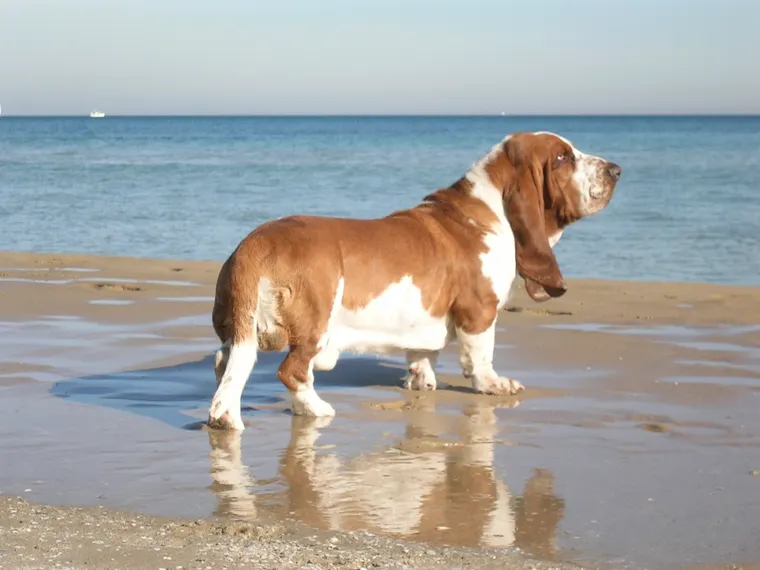
Bassets are champion eaters on short legs: the breed is noted as obesity-prone, and every extra kilogram lands on a chondrodystrophic spine and heavy front that already carry elevated risk of intervertebral disc disease and elbow dysplasia — measure every meal, keep treats under 10% of daily calories, and hold body condition score 4–5/9. A 25 kg neutered adult needs only about 1,100–1,250 kcal a day (RER = 70 × 25^0.75 = 783, × 1.4–1.6). Deep-chested and prone to gastric torsion, they should eat two smaller meals rather than one large one, and their long pendulous ears mean food-motivated rooting and ear infections go together — check ears weekly.
Basset Hound puppy growth chart — male & female
Healthy weight ranges by age. A puppy slightly lean is healthier than slightly heavy — especially for growing dogs.
View the month-by-month table — or see the full Basset Hound weight chart with graphics →
♂ Male
| Age | Range (kg · lb) |
|---|---|
| 2 mo | 7–9 kg · 15–20 lb |
| 3 mo | 11.5–14.5 kg · 25–32 lb |
| 4 mo | 16–20 kg · 35–44 lb |
| 5 mo | 19.5–24.5 kg · 43–54 lb |
| 6 mo | 22.5–28.5 kg · 50–63 lb |
| 8 mo | 25.5–32 kg · 56–71 lb |
| 12 mo | 27.5–34.5 kg · 61–76 lb |
| 18 mo | 20–35 kg · 44–77 lb |
♀ Female
| Age | Range (kg · lb) |
|---|---|
| 2 mo | 6.5–8 kg · 14–18 lb |
| 3 mo | 11–13.5 kg · 24–30 lb |
| 4 mo | 14.5–18 kg · 32–40 lb |
| 5 mo | 18–22.5 kg · 40–50 lb |
| 6 mo | 21–26 kg · 46–57 lb |
| 8 mo | 23.5–29.5 kg · 52–65 lb |
| 12 mo | 25.5–31.5 kg · 56–69 lb |
| 18 mo | 18.5–32 kg · 41–71 lb |
Reference: Weight: Wikipedia infobox 20-35 kg (45-75 lb), single range, no sex split — AKC breed info lists 40-65 lb (18-29.5 kg), so standards differ; female range derived as ×0.92 (estimate); growth midpoints per medium-breed developmental ratios on body weight (estimate); breed health notes (obesity, IVD, gastric torsion): Wikipedia citing breed literature; GDV meal-frequency: Glickman et al. 2000 JAVMA; obesity prevalence: APOP. Always confirm against your vet's assessment — individual lines vary.
How much should a Basset Hound puppy eat?
Meal frequency and food type for a growing Basset Hound:
| Age | Meals | Food type | Watch for |
|---|---|---|---|
| 8–12 weeks | 3–4 × daily | puppy formula | Soak kibble warm water 10 min if still soft; weigh weekly. |
| 3–6 months | 3 × daily | puppy formula | Peak growth — feed to the chart, never free-feed; keep puppy lean. |
| 6–12 months | 2 × daily | puppy formula | Growth slows; reduce portions if ribs get hard to feel. |
| → adult (12 months) | 2 × daily | adult formula | Transition over 7–10 days, mixing increasing adult food. |
Basset Hound milestones
What happens when — eyes, teeth, maturity, and when hard exercise is safe:
How much should I feed my pregnant or nursing Basset Hound?
Pregnancy and lactation are the highest-energy periods your Basset Hound will ever go through — at peak milk production a mother burns 3–4× her normal resting energy. For a typical 22.5 kg Basset Hound mother (RER = 723 kcal):
| Stage | Energy need | ≈ kcal/day | Food |
|---|---|---|---|
| Pregnancy, weeks 1–6 | Normal adult amount | — | Her usual adult formula |
| Pregnancy, weeks 6–9 | ~1.5–2× RER, climbing | ~1,301 | Switch to a growth/puppy formula |
| Nursing, weeks 3–4 (peak) | 3–4× RER | 2,169–2,892 | Puppy formula, often free-choice |
| Weaning (milk dries up) | Back toward normal | — | Gradual return to adult formula |
The puppy-formula switch in late pregnancy is standard veterinary practice (energy-dense and calcium-balanced for fetal and milk production). Litter size and body condition shift the numbers — confirm the plan with your vet, and re-run the calculator at her current weight each week.
Frequently asked questions
How much should a Basset Hound eat per day?
A typical 25 kg neutered adult needs about 1,100–1,250 kcal per day (RER = 70 × 25^0.75 = 783, × 1.4–1.6) — roughly 2¾–3 cups of a 400 kcal/cup food. Bassets will happily eat double that, so portion with a measuring cup or gram scale and re-weigh monthly; the breed's healthy span runs 20–35 kg, so the target has to come from body condition, not the scale alone.
Why do Basset Hounds get overweight so easily?
They were bred for endurance scenting and will eat whenever food is available, on a frame built low to the ground — the breed is specifically noted as prone to obesity, and roughly 6 in 10 U.S. dogs are already overweight (APOP). The cost is specific: extra weight loads a long spine prone to intervertebral disc disease and heavy, dysplasia-prone front joints. Measure meals, keep treats under 10% of daily calories, and aim for ribs you can feel with light pressure (body condition score 4–5/9).
How much should a Basset Hound puppy weigh?
Per the growth chart above, a male runs about 7–9 kg at 2 months, 22.5–28.5 kg at 6 months, and reaches his adult 20–35 kg by 12–18 months (females finish slightly lighter at 18.5–32 kg). A 3-month puppy (around 11.5–14.5 kg) needs roughly 900–1,000 kcal a day (≈2 × RER) split across 3 meals. Puppies look adorable round — keep the curve lean instead.
When should I switch my Basset Hound puppy to adult food?
Around 12 months. Bassets are a medium breed with heavy bone that keeps filling out past their first birthday, so a standard AAFCO growth formula is right (no giant-breed formula needed), transitioning over 7–10 days. The bigger issue is the day after the switch: recalculate portions from the adult food's calorie density, because a food-motivated breed on eyeballed cups is how obesity starts.
Should a Basset Hound eat once or twice a day?
Twice a day. Bassets are deep-chested for their height and prone to gastric torsion (bloat), and Purdue GDV research (Glickman et al., JAVMA 2000) found dogs fed a single large daily meal had roughly twice the GDV risk of dogs fed two or more smaller meals. Split the ration into two measured meals, use a slow feeder if yours gulps, and avoid hard exercise for about an hour around mealtimes (AVMA guidance).