Pitbull feeding guide
"Pitbull" is not a single AKC breed — it's an umbrella term covering several related breeds. This guide provides feeding data for the three most common: the American Pit Bull Terrier, the American Bully, and the American Staffordshire Terrier. Each has its own data below.
What all pitbulls share
Every pit bull type — APBT, AmStaff, American Bully, and mixes — shares three traits that shape feeding. First, muscular build hides fat: on a heavily muscled dog, the number on the scale is a poor guide, so judge condition by touch. Run your fingers along the ribs weekly: you should feel them under a thin fat layer, like the back of your hand. From above, a waist should narrow behind the ribs; from the side, there should be an abdominal tuck. If you are digging through fat to find ribs, the dog is already overweight however "solid" it looks. Second, food drive: these are famous eaters that will accept unlimited food and beg convincingly between meals. Begging is not caloric need — measure meals, keep treats under 10% of daily calories, and pay training rewards out of the kibble ration rather than on top of it. Third, obesity risk: muscle does not burn enough extra to offset free-feeding, and every extra kilogram loads the joints underneath that muscle. Weigh monthly, adjust portions to hold a steady body condition score of 4-5/9, and feed a complete AAFCO diet — muscular dogs need normal protein levels, not supplement stacks.
- Yes
- No
- Normal
- Active — daily training / long runs
- Working dog — sled, hunting, herding
- On a weight-loss plan
Skip if you only need calories. 93 verified foods — or pick "My food isn't listed" to enter kcal from the bag.
Copy both from the bag's Calorie Content (ME) label — dry foods typically run 3,300–4,200 kcal/kg.
Estimates only — not veterinary advice
Feeding guides are a starting point — individual dogs vary with metabolism, activity, and body condition. Adjust by how your dog looks and feels, and talk to your vet before major changes.
American Pit Bull Terrier feeding chart
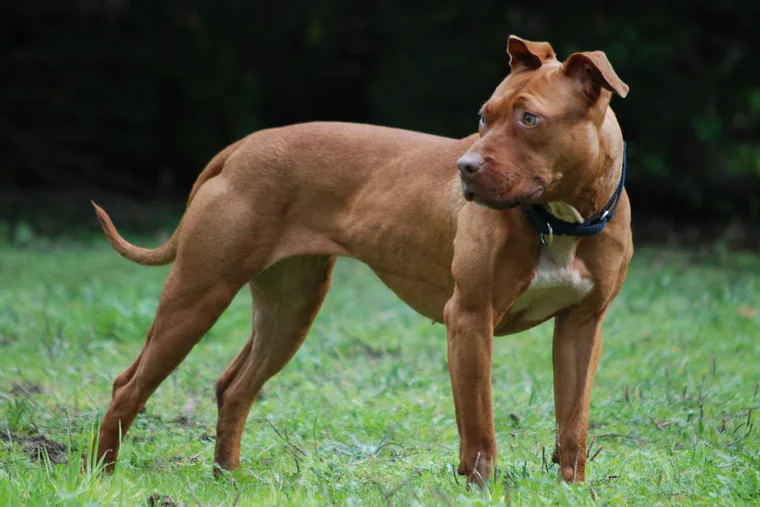
Adult weight range: 16–27 kg · 35–60 lb
♂ Male growth (kg · lb)
| Age | Healthy range (kg · lb) |
|---|---|
| 2 mo | 4–6.5 kg · 9–14 lb |
| 3 mo | 6.5–10.5 kg · 14–23 lb |
| 4 mo | 9–14 kg · 20–31 lb |
| 5 mo | 11.5–17 kg · 25–37 lb |
| 6 mo | 13.5–20 kg · 30–44 lb |
| 8 mo | 15.5–22.5 kg · 34–50 lb |
| 12 mo | 16–25.5 kg · 35–56 lb |
| 18 mo | 16–27 kg · 35–60 lb |
♀ Female growth (kg · lb)
| Age | Healthy range (kg · lb) |
|---|---|
| 2 mo | 3.5–5.5 kg · 8–12 lb |
| 3 mo | 5.5–9 kg · 12–20 lb |
| 4 mo | 7.5–12 kg · 17–26 lb |
| 5 mo | 9.5–14.5 kg · 21–32 lb |
| 6 mo | 11–17 kg · 24–37 lb |
| 8 mo | 12.5–19.5 kg · 28–43 lb |
| 12 mo | 13.5–22 kg · 30–49 lb |
| 18 mo | 13.5–23 kg · 30–51 lb |
The APBT is the athlete of the pit bull family: the UKC standard demands a dog that is both "powerful and agile" and faults any specimen that looks bulky or muscle-bound. That lean working build is the reference point for feeding. A conditioned adult (males 35-60 lb / 16-27 kg) typically needs 980-1,140 kcal per day, but dogs doing real work — hiking, weight pull, daily running — can need 20-30% more, and couch weeks call for cutting back just as fast. Muscle hides fat poorly here, so judge condition by feel, not by weight alone: ribs should be easy to find under a thin fat layer, with a visible waist from above and an abdominal tuck from the side. Strong food drive means an APBT will always accept more food than it needs and will train its owner into extra portions through sheer persistence — budget treats into the day's calories rather than adding them on top. Keep growing puppies lean; a heavy pit bull puppy carries avoidable stress on developing joints.
American Bully feeding chart
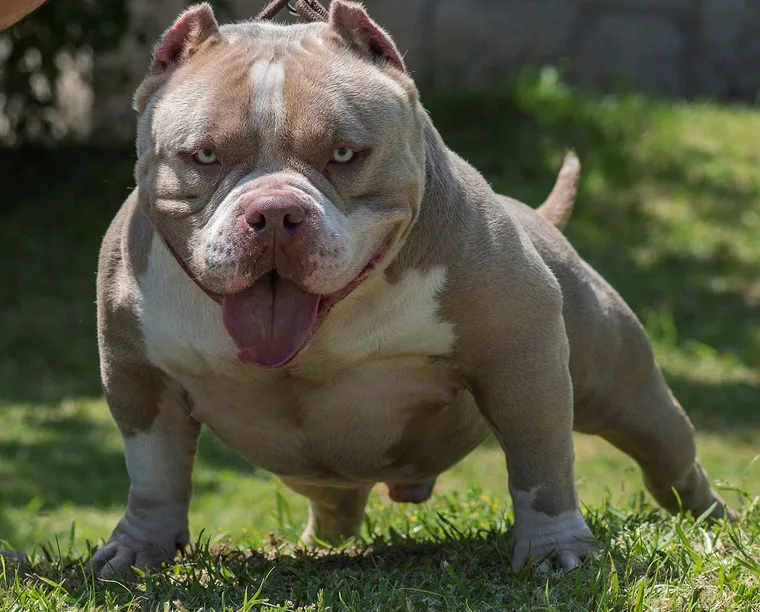
Adult weight range: 20–60 kg · 44–132 lb
♂ Male growth (kg · lb)
| Age | Healthy range (kg · lb) |
|---|---|
| 2 mo | 5.5–16 kg · 12–35 lb |
| 3 mo | 9–27 kg · 20–60 lb |
| 4 mo | 12–36 kg · 26–79 lb |
| 5 mo | 14.5–44 kg · 32–97 lb |
| 6 mo | 16.5–50 kg · 36–110 lb |
| 8 mo | 18.5–56 kg · 41–123 lb |
| 12 mo | 19–58.5 kg · 42–129 lb |
| 18 mo | 20–60 kg · 44–132 lb |
♀ Female growth (kg · lb)
| Age | Healthy range (kg · lb) |
|---|---|
| 2 mo | 5–13.5 kg · 11–30 lb |
| 3 mo | 8–22.5 kg · 18–50 lb |
| 4 mo | 10.5–30 kg · 23–66 lb |
| 5 mo | 13–36.5 kg · 29–80 lb |
| 6 mo | 15–41 kg · 33–90 lb |
| 8 mo | 17–46 kg · 37–101 lb |
| 12 mo | 17.5–48 kg · 39–106 lb |
| 18 mo | 18–50 kg · 40–110 lb |
No single plan fits this breed: ABKC varieties span roughly 30 to 60+ kg between an adult Pocket male and an XL male, so calories must be calculated from the dog's own frame and actual weight, never from the breed label. The ABKC standard itself sets no weight, requiring only that weight stay in proportion to frame and that a dog "NOT reach the point where it is considered obese" — that clause matters most. Bullies are built dense but most live as low-activity companions, so daily needs run lower than their mass suggests: roughly 980 kcal for a 40 lb Pocket, 1,800 for a 90 lb Standard, 2,230 for a 120 lb XL, and free-pouring overshoots fast. Joint health is the central feeding issue: heavy frames loaded onto growing joints mean Standard and XL puppies should grow slowly on a large-breed puppy formula with controlled calcium, stay lean (BCS 4-5/9) throughout growth, and be weighed every 2-4 weeks. Resisting the urge to "bulk up" a young bully protects hips, elbows and knees for life.
American Staffordshire Terrier feeding chart
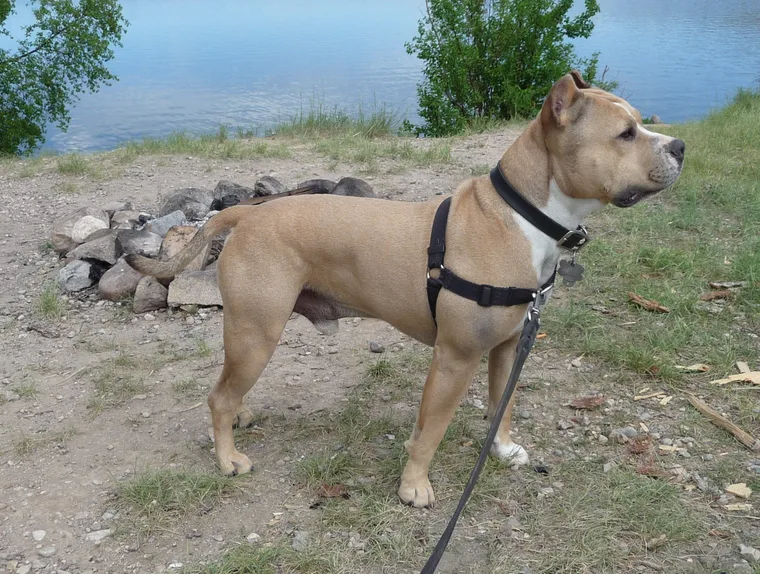
Adult weight range: 25–32 kg · 55–71 lb
♂ Male growth (kg · lb)
| Age | Healthy range (kg · lb) |
|---|---|
| 2 mo | 6–8 kg · 13–18 lb |
| 3 mo | 10–13 kg · 22–29 lb |
| 4 mo | 13.5–17.5 kg · 30–39 lb |
| 5 mo | 17–21.5 kg · 37–47 lb |
| 6 mo | 20–25 kg · 44–55 lb |
| 8 mo | 22.5–28 kg · 50–62 lb |
| 12 mo | 24–30.5 kg · 53–67 lb |
| 18 mo | 25–32 kg · 55–71 lb |
♀ Female growth (kg · lb)
| Age | Healthy range (kg · lb) |
|---|---|
| 2 mo | 4.5–6 kg · 10–13 lb |
| 3 mo | 7.5–10 kg · 17–22 lb |
| 4 mo | 10–13.5 kg · 22–30 lb |
| 5 mo | 12.5–16.5 kg · 28–36 lb |
| 6 mo | 14.5–19 kg · 32–42 lb |
| 8 mo | 16.5–21.5 kg · 36–47 lb |
| 12 mo | 17.5–23.5 kg · 39–52 lb |
| 18 mo | 18–25 kg · 40–55 lb |
The AmStaff is the stockier AKC cousin of the APBT: at 18-19 inches a male carries 55-70 lb (25-32 kg), so there is more mass per centimeter of height and less margin for extra pounds. Calorie needs look moderate on paper — roughly 1,060 kcal for a typical 20 kg female and 1,360 kcal for a 28 kg male — but the breed shares the family food drive and will overeat enthusiastically if meals are free-poured. Measure every meal, re-weigh monthly, and keep treats under 10% of daily calories. The build makes body condition easy to misjudge: a broad chest and heavy muscling read as "solid" even when a fat layer is present, so rely on the rib check — ribs found easily under thin cover, a visible waist from above, an abdominal tuck from the side. Skin and coat problems are commonly reported in the breed; a complete AAFCO diet with omega-3 fatty acids (EPA/DHA) supports coat health, but persistent itching needs a vet workup, not random food changes.
Which one is my dog?
Without registration papers, most pitbull-type dogs are best described as "pitbull-type mix" — and that's what vets and shelters do too. If you want to know specifically, a dog DNA test (Embark, Wisdom Panel) is the most reliable option. For feeding purposes, use your dog's current weight and body condition rather than trying to match a specific breed standard — the calculator above handles any weight.
Related guide: Staffordshire Bull Terrier (the UK cousin)
FAQ
How much should I feed my pitbull?
Start from actual weight: a typical 25 kg (55 lb) neutered adult pitbull-type needs about 1,250 kcal per day (RER 783 x 1.6) — roughly 3 cups of a typical 400 kcal/cup dry food. Because "pitbull" covers dogs from a 16 kg APBT to a 60 kg XL Bully, the honest range runs from about 900 to 2,200+ kcal per day. Calculate for your dog's current weight, then adjust in 10% steps every two weeks based on the rib check, not the bowl.
Is my dog an American Pit Bull Terrier, AmStaff, or American Bully?
Size and registration paperwork give the best clues. The APBT (UKC) is the leanest: 35-60 lb on a 18-21 inch frame. The AmStaff (AKC) is stockier for its height: 55-70 lb on 18-19 inches. The American Bully (UKC/ABKC) is the most thickset, with four height varieties from 14-inch Pockets to 23-inch XLs that can top 120 lb. Without papers, visual ID between these breeds — and in mixed-breed shelter dogs generally — is unreliable even for experts; a DNA test answers the question, and "pitbull-type mix" is the honest default label.
Why is my pitbull always hungry?
Strong food drive is a breed trait, not necessarily a calorie deficit. Pit bull types were historically selected for eagerness and intensity, and that intensity lands squarely on food: many will eat far past their needs and beg just as hard right after dinner. If portions already match the calculator's target for your dog's weight and the rib check shows ideal condition (4-5/9), the begging is behavior, not hunger — address it with measured meals, a slow-feeder bowl, and vegetables as low-calorie toppers. If hunger is genuinely new, increasing, or paired with weight loss, see your vet to rule out medical causes.
What is the best feeding schedule for pitbull puppies?
Four measured meals a day at 8-12 weeks, three meals through roughly 6 months, then two meals a day — morning and evening — for life. Pit bull puppies are fast, enthusiastic eaters, so use a slow-feeder bowl or snuffle mat and stick to fixed times; a predictable schedule also speeds up housetraining. Puppies need about twice the calories per kilogram of adults, but keep the body condition at 4-5/9 throughout growth, and let Standard/XL Bully puppies mature slowly on a large-breed formula until 12-18 months depending on variety.