Goldendoodle feeding guide
The Goldendoodle is a designer dog created by crossing a Golden Retriever with a Poodle, and it is not recognized as a breed by the AKC or any other major kennel club. Because the Poodle parent comes in toy, miniature, and standard sizes, Goldendoodles are bred in three size categories — mini, medium, and standard — and two puppies from the same litter can differ by more than 15 kg (33 lb) as adults. The breed's parent club, GANA (Goldendoodle Association of North America), defines these categories by height at the withers and warns that a breeder's puppy-size estimate is only an educated guess. For feeding, the dog's actual current weight and size category matter far more than the name "Goldendoodle": a 12 kg Mini and a 32 kg Standard can differ by close to 1,000 kcal per day.
What all Goldendoodles share
Feeding a Goldendoodle starts with one admission: the Golden Retriever side of the cross brings a hearty appetite and a well-documented tendency toward weight gain, while the Poodle side largely determines the frame it lands on. Most Goldendoodles will eat well past satiety and then lobby for more, so measured meals — never free-feeding — should start in puppyhood. Daily energy needs track the size variant: a typical adult Mini (10-16 kg) maintains on roughly 550-900 kcal, a Medium (16-23 kg) on roughly 800-1,200 kcal, and a Standard (23-38 kg) on roughly 1,050-1,800 kcal. Standards doing service, therapy, or sport work can need 20-40% above maintenance, while a weekend-walk family dog often sits at the low end. Large-breed puppy nutrition matters for the taller variants: Standards should grow slowly and stay lean, because their growth plates do not close until roughly 14-18 months and extra weight during that window loads developing joints. The Doodle coat is also effective camouflage — it hides both ribs and fat — so rely on hands-on checks (ribs easily felt, visible waist from above, abdominal tuck from the side) rather than how fluffy the dog looks. Weigh monthly through the first 18 months, then quarterly, and re-run the numbers whenever weight moves.
- Yes
- No
- Normal
- Active — daily training / long runs
- Working dog — sled, hunting, herding
- On a weight-loss plan
Skip if you only need calories. 93 verified foods — or pick "My food isn't listed" to enter kcal from the bag.
Copy both from the bag's Calorie Content (ME) label — dry foods typically run 3,300–4,200 kcal/kg.
Estimates only — not veterinary advice
Feeding guides are a starting point — individual dogs vary with metabolism, activity, and body condition. Adjust by how your dog looks and feels, and talk to your vet before major changes.
Mini Goldendoodle — feeding chart & growth
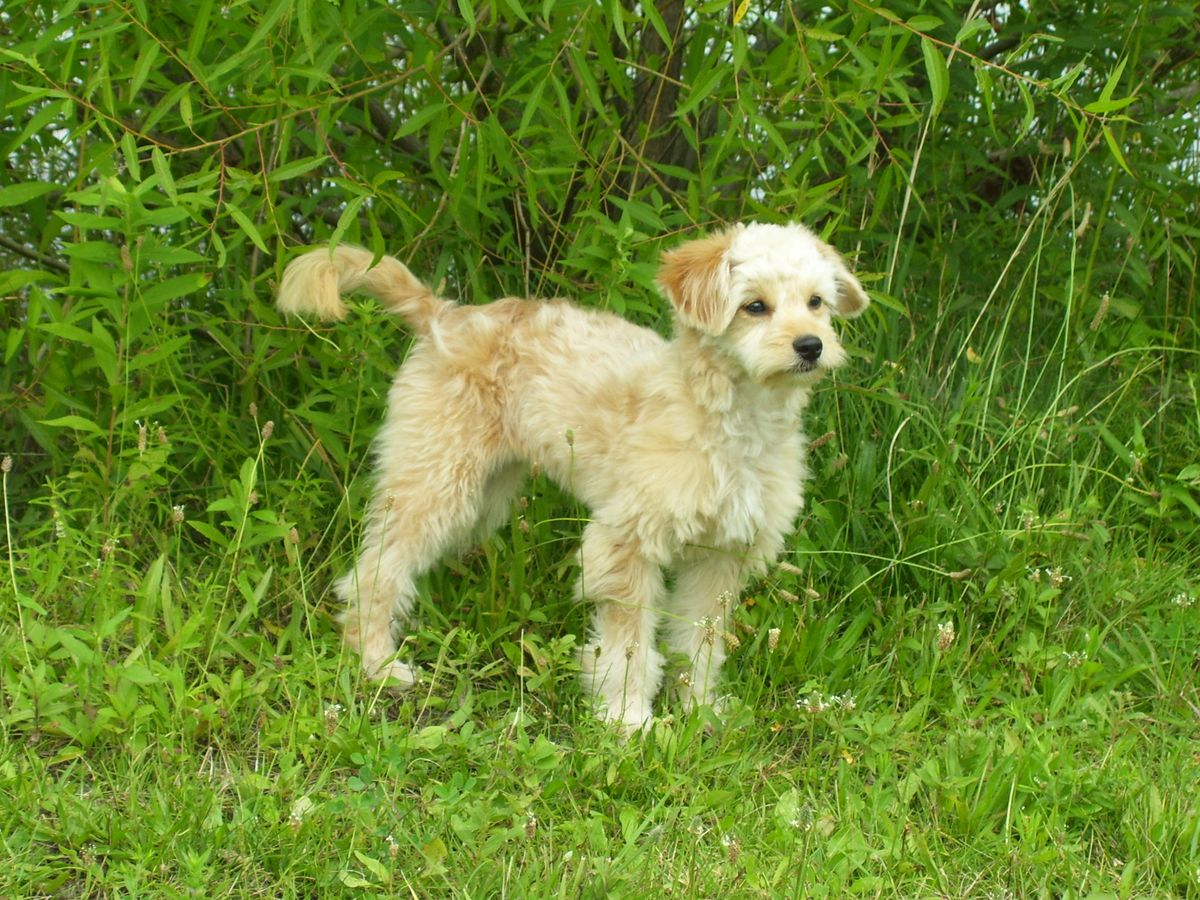
Adult weight range: 10–16 kg · 22–35 lb
♂ Male
| Age | Healthy range (kg · lb) |
|---|---|
| 2 mo | 2–4 kg · 4–9 lb |
| 3 mo | 4–5.5 kg · 9–12 lb |
| 4 mo | 5–7 kg · 11–15 lb |
| 5 mo | 6.5–9 kg · 14–20 lb |
| 6 mo | 7.5–10.5 kg · 17–23 lb |
| 8 mo | 9–12.5 kg · 20–28 lb |
| 12 mo | 9.5–15.5 kg · 21–34 lb |
| 18 mo | 10–16 kg · 22–35 lb |
♀ Female
| Age | Healthy range (kg · lb) |
|---|---|
| 2 mo | 2–3.5 kg · 4–8 lb |
| 3 mo | 3.5–5 kg · 8–11 lb |
| 4 mo | 4.5–6.5 kg · 10–14 lb |
| 5 mo | 6–8.5 kg · 13–19 lb |
| 6 mo | 7–10 kg · 15–22 lb |
| 8 mo | 8.5–11.5 kg · 19–25 lb |
| 12 mo | 9–14 kg · 20–31 lb |
| 18 mo | 9–14.5 kg · 20–32 lb |
Medium Goldendoodle — feeding chart & growth
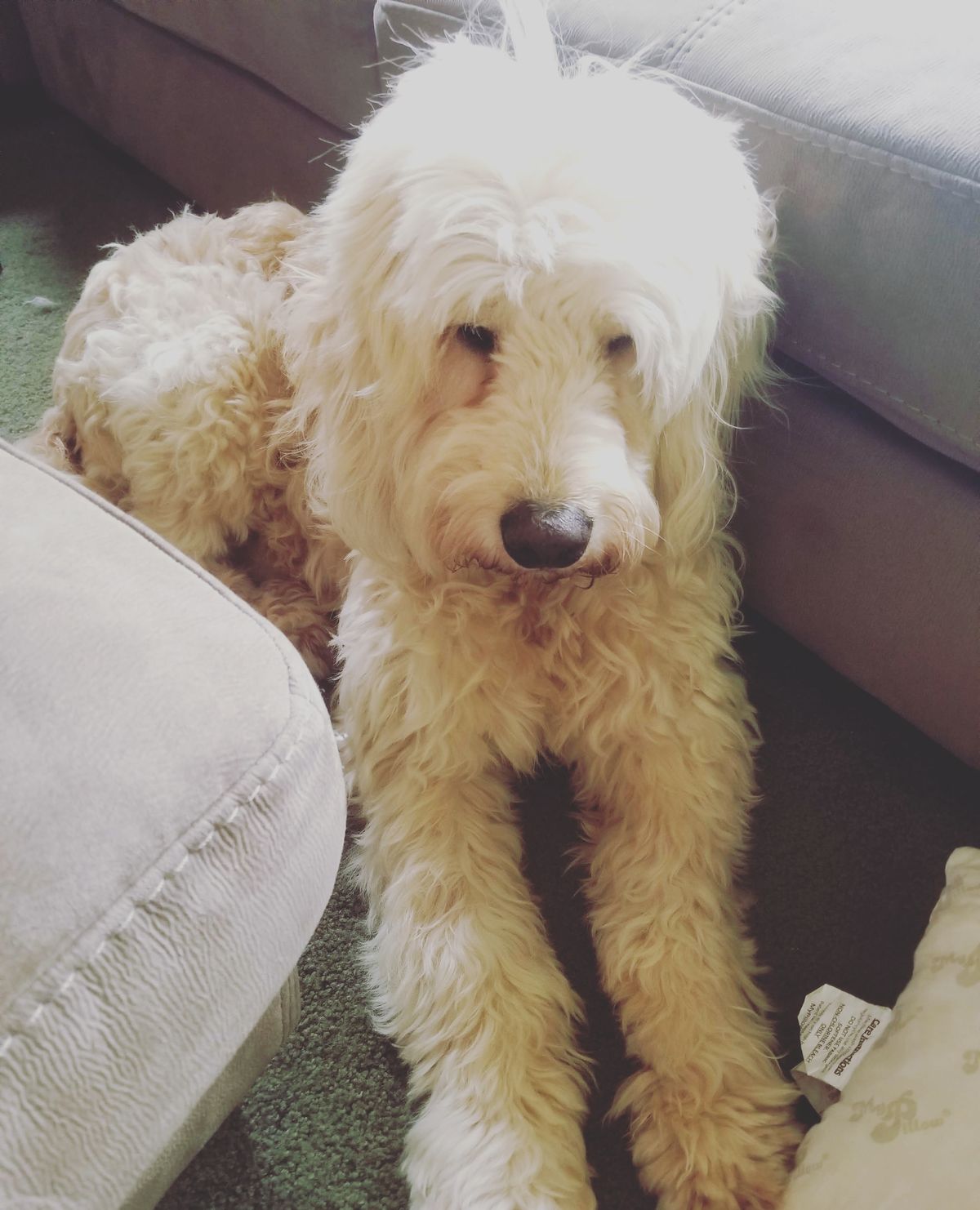
Adult weight range: 16–23 kg · 35–51 lb
♂ Male
| Age | Healthy range (kg · lb) |
|---|---|
| 2 mo | 3–5 kg · 7–11 lb |
| 3 mo | 4.5–8.5 kg · 10–19 lb |
| 4 mo | 6.5–11 kg · 14–24 lb |
| 5 mo | 8.5–13.5 kg · 19–30 lb |
| 6 mo | 10.5–16 kg · 23–35 lb |
| 8 mo | 12.5–19.5 kg · 28–43 lb |
| 12 mo | 15.5–22 kg · 34–49 lb |
| 18 mo | 16–23 kg · 35–51 lb |
♀ Female
| Age | Healthy range (kg · lb) |
|---|---|
| 2 mo | 2.5–4.5 kg · 6–10 lb |
| 3 mo | 4–7.5 kg · 9–17 lb |
| 4 mo | 5.5–10 kg · 12–22 lb |
| 5 mo | 7.5–12.5 kg · 17–28 lb |
| 6 mo | 9–14 kg · 20–31 lb |
| 8 mo | 11–17.5 kg · 24–39 lb |
| 12 mo | 13.5–21 kg · 30–46 lb |
| 18 mo | 14–21.5 kg · 31–47 lb |
Standard Goldendoodle — feeding chart & growth
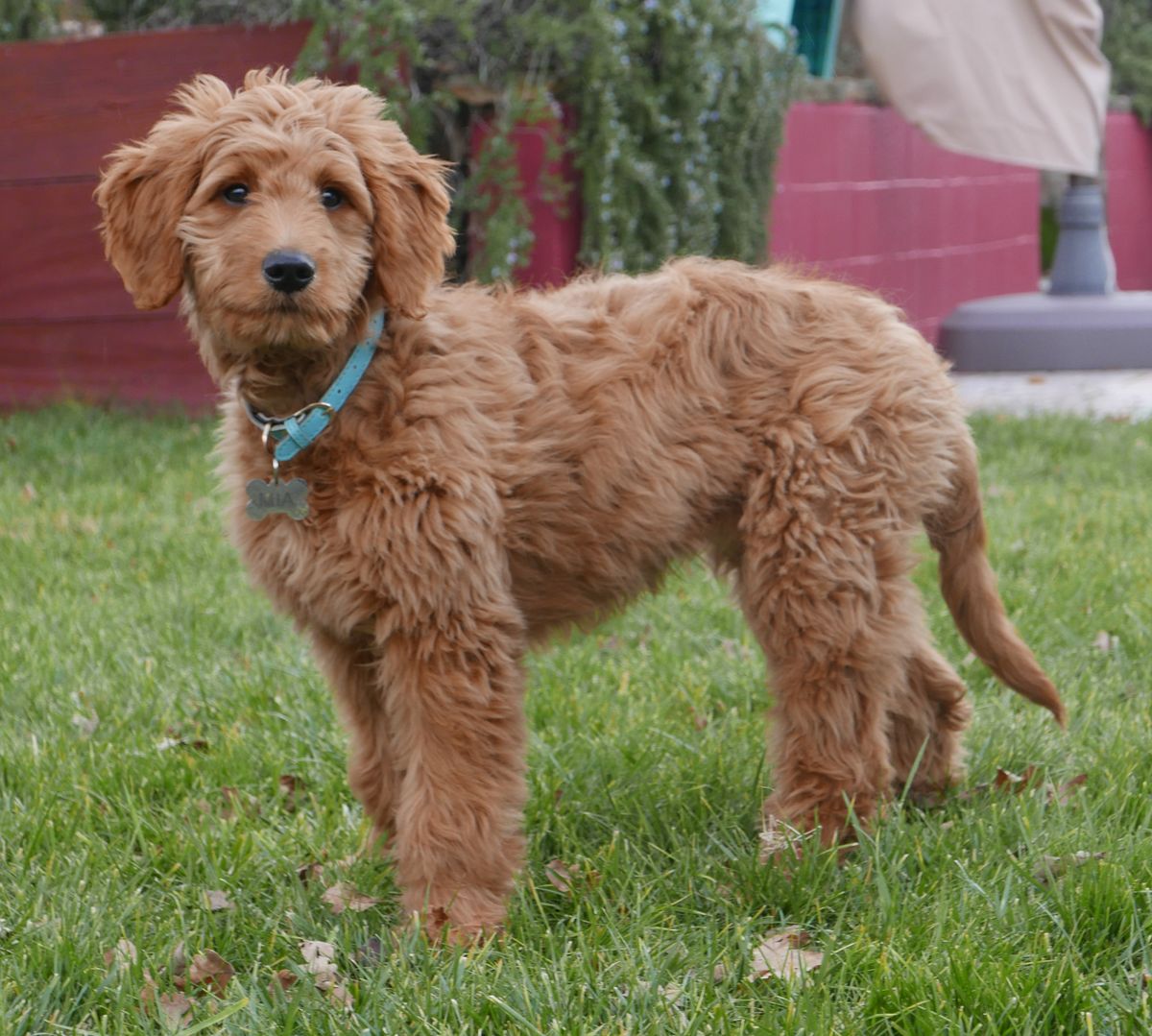
Adult weight range: 23–38 kg · 51–84 lb
♂ Male
| Age | Healthy range (kg · lb) |
|---|---|
| 2 mo | 4–8 kg · 9–18 lb |
| 3 mo | 6.5–12.5 kg · 14–28 lb |
| 4 mo | 9–16.5 kg · 20–36 lb |
| 5 mo | 11.5–20 kg · 25–44 lb |
| 6 mo | 14–24.5 kg · 31–54 lb |
| 8 mo | 17–29.5 kg · 37–65 lb |
| 12 mo | 22–36 kg · 49–79 lb |
| 18 mo | 23–38 kg · 51–84 lb |
♀ Female
| Age | Healthy range (kg · lb) |
|---|---|
| 2 mo | 3.5–7.5 kg · 8–17 lb |
| 3 mo | 6–11.5 kg · 13–25 lb |
| 4 mo | 8.5–16 kg · 19–35 lb |
| 5 mo | 10.5–19 kg · 23–42 lb |
| 6 mo | 12–22 kg · 26–49 lb |
| 8 mo | 15–26 kg · 33–57 lb |
| 12 mo | 19.5–31.5 kg · 43–69 lb |
| 18 mo | 20–32.5 kg · 44–72 lb |
Frequently asked questions
How much should I feed my Goldendoodle?
Feed by your dog's actual weight and size category, not by the name Goldendoodle. A 13 kg (29 lb) Mini needs about 750-850 kcal per day — roughly 2 cups of a typical 400 kcal/cup dry food — while a 30 kg (66 lb) Standard needs about 1,400-1,500 kcal, or roughly 3½ cups. Minis (10-16 kg) typically maintain on 550-900 kcal, Mediums (16-23 kg) on 800-1,200 kcal, and Standards (23-38 kg) on 1,050-1,800 kcal. Start from your dog's current weight, then adjust in 10% steps based on body condition and monthly weigh-ins.
How often should I feed a Goldendoodle puppy?
Feed 3-4 measured meals per day at 8-12 weeks, drop to 3 meals by 4-6 months, and 2 meals from around 6 months onward. Splitting the day's calories matters more for the larger variants: Standards that gulp one big meal eat fast and swallow air, and large, deep-chested dogs have a higher risk of bloat (GDV). Avoid hard exercise for about an hour before and after meals, and keep treats under 10% of daily calories — Goldendoodles inherit the Golden Retriever's food drive and will happily train you into over-treating.
How different are the feeding amounts for a Mini versus a Standard Goldendoodle?
The gap is bigger than most owners expect — often a full 2x. A Mini maintaining on 600 kcal needs less than half the food of a Standard maintaining on 1,400 kcal, and puppy portions diverge even earlier because Minis reach adult size around 11-13 months while Standards grow until 18-24 months. If you have two doodles of different sizes, portion each one separately with a measuring cup or kitchen scale; feeding both 'the same because they're the same breed' is one of the fastest routes to an overweight Mini.
When is a Goldendoodle fully grown?
It depends on the size category. Minis reach adult height around 9-11 months and adult weight by about 11-13 months. Mediums finish height around 11-13 months and reach adult weight by 12-15 months. Standards reach most of their height by 12-15 months but keep filling out with muscle until 18-24 months. Switch from puppy to adult food at around 12 months for Minis and Mediums, and between 12 and 18 months for Standards — large-breed puppies benefit from staying on a large-breed puppy formula while their growth plates are still open.
How much should a Goldendoodle weigh?
There is no single answer — the Goldendoodle spans three size classes. Per the GANA breed standard: Minis typically 26-35 lb (12-16 kg), Mediums 36-50 lb (16-23 kg), and Standards 51 lb or more (23 kg and up, with most adults between 51 and 84 lb / 23-38 kg). GANA defines the categories by height at the withers because weight fluctuates, and females typically run 10-15% lighter than males in the same category. Anywhere inside the right range for your dog's frame is normal — body condition matters more than the number on the scale.
How do I switch my Goldendoodle to a new food?
Transition over 7-10 days: start with roughly 25% new food and 75% old, and shift the ratio every 2-3 days. Goldendoodles with the Golden Retriever's sensitive digestion sometimes need 10-14 days. Two practical notes: first, compare calorie density — a cup of one kibble can be 340 kcal while another is 430, so portion sizes need to change when the food changes. Second, don't judge the switch on one soft stool; only slow down or step back if loose stools persist beyond a couple of days.
Why are Goldendoodle littermates so different in size?
Because the Poodle parent comes in three sizes and hybrid genetics reshuffle the deck every generation. An F1 litter from a 60 lb Golden Retriever and a 45 lb Standard Poodle can produce adults ranging from about 45 to 75 lb, and multigenerational breedings can produce puppies larger than either parent when the Golden Retriever grandparent's size comes through. F1b litters (75% Poodle) tend to track the Poodle parent's size more closely. GANA states plainly that a breeder's size estimate for a puppy is an educated guess, which is why feeding should always follow actual weight rather than the label the puppy came with.
What is the best dog food for a Goldendoodle?
No specific brand is 'the' Goldendoodle food — what matters is matching the food to the dog. Look for a diet labeled complete and balanced for the right life stage (AAFCO statement in the US), choose a large-breed puppy formula for Standard puppies to control calcium and growth rate, and pick a calorie density that makes portioning practical for your dog's size. Goldendoodles do well on most quality diets; the breed's real nutritional issue is quantity, not brand, because of the Golden Retriever side's appetite. If your dog has allergies, GI issues, or a weight problem that portion control hasn't fixed, your vet is the right next stop.