Dog crate size calculator
The weight chart below gets you close; your tape measure gets you right. For ten breeds the weight chart actively misleads — their pages explain why.
The weight chart, honestly
Standard sizing tiers by adult weight — where the industry consensus starts:
| Adult weight | Crate length | Typical breeds |
|---|---|---|
| ≤10 lb (≤4.5 kg) | 18-inch | Chihuahua, Italian Greyhound |
| 11–25 lb (5–11 kg) | 24-inch | Cavalier, Maltese, Dachshund (mini) |
| 26–40 lb (12–18 kg) | 30-inch | Beagle, Cocker Spaniel |
| 41–70 lb (19–32 kg) | 36-inch | Pitbull, Husky, Australian Shepherd |
| 71–90 lb (33–41 kg) | 42-inch | Labrador, Golden, German Shepherd* |
| 90+ lb (41+ kg) | 48-inch | Great Dane, Mastiff, Saint Bernard |
* The starred entries are exactly where weight-only sizing fails — deep-chested GSDs and long-bodied breeds need more length than their weight suggests. Breed pages below cover the known exceptions.
Quick reference: 65 breeds
Breeds with their own crate guide are linked — those pages carry official shoulder heights and breed-specific crate knowledge. The rest: find your dog's weight row in the chart above.
| Breed | Adult weight | Crate | Guide |
|---|---|---|---|
| Akita | 70–130 lb | 48" | — |
| Alaskan Malamute | 67–94 lb | 48" | — |
| Australian Cattle Dog | 33–66 lb | 36" | — |
| Australian Shepherd | 32–71 lb | 42" | — |
| Basset Hound | 41–77 lb | 42" | — |
| Beagle | 20–25 lb | 30" | Why → |
| Belgian Malinois | 44–66 lb | 36" | — |
| Bernese Mountain Dog | 75–121 lb | 48" | — |
| Bichon Frise | 11–18 lb | 24" | — |
| Border Collie | 26–55 lb | 36" | — |
| Boston Terrier | 11–25 lb | 24" | — |
| Boxer | 51–79 lb | 42" | — |
| Brittany | 29–44 lb | 36" | — |
| Bull Terrier | 50–70 lb | 42" | — |
| Bulldog | 40–55 lb | 36" | — |
| Cane Corso | 88–110 lb | 48" | — |
| Cardigan Welsh Corgi | 24–37 lb | 30" | — |
| Cavalier King Charles Spaniel | 12–18 lb | 24" | Why → |
| Chihuahua | 3–6 lb | 18" | — |
| Chow Chow | 55–71 lb | 42" | — |
| Cockapoo | 20–31 lb | 30" | — |
| Cocker Spaniel | 20–31 lb | 30" | — |
| Dachshund | 17–32 lb | 30" | Why → |
| Dalmatian | 45–70 lb | 42" | — |
| Doberman Pinscher | 71–99 lb | 48" | — |
| English Setter | 45–80 lb | 42" | — |
| English Springer Spaniel | 35–60 lb | 36" | — |
| French Bulldog | 18–31 lb | 30" | Why → |
| German Shepherd | 50–90 lb | 48" | Why → |
| German Shorthaired Pointer | 45–71 lb | 42" | — |
| Giant Schnauzer | 71–104 lb | 48" | — |
| Golden Retriever | 55–75 lb | 42" | Why → |
| Goldendoodle | 51–84 lb | 42" | Why → |
| Great Dane | 110–175 lb | 48" | — |
| Great Pyrenees | 99–119 lb | 48" | — |
| Greyhound | 55–88 lb | 42" | Why → |
| Havanese | 6–14 lb | 24" | — |
| Labrador Retriever | 55–79 lb | 42" | Why → |
| Lurcher | 35–71 lb | 42" | — |
| Maltese | 7–9 lb | 18" | — |
| Mastiff | 162–187 lb | 48" | — |
| Miniature Poodle | 9–15 lb | 24" | — |
| Miniature Schnauzer | 11–20 lb | 24" | — |
| Newfoundland | 130–150 lb | 48" | — |
| Pembroke Welsh Corgi | 24–31 lb | 30" | — |
| Pitbull | 35–60 lb | 42" | Why → |
| Pomeranian | 3–7 lb | 18" | — |
| Pug | 13–18 lb | 24" | — |
| Rhodesian Ridgeback | 75–85 lb | 42" | — |
| Rottweiler | 77–132 lb | 48" | — |
| Saint Bernard | 119–181 lb | 48" | — |
| Samoyed | 45–65 lb | 36" | — |
| Scottish Terrier | 19–22 lb | 24" | — |
| Shar Pei | 45–60 lb | 36" | — |
| Shetland Sheepdog | 14–25 lb | 24" | — |
| Shiba Inu | 17–23 lb | 24" | — |
| Shih Tzu | 9–16 lb | 24" | — |
| Siberian Husky | 35–60 lb | 36" | — |
| Staffordshire Bull Terrier | 24–37 lb | 30" | — |
| Standard Poodle | 44–71 lb | 42" | — |
| Vizsla | 40–64 lb | 36" | — |
| Weimaraner | 55–88 lb | 42" | — |
| West Highland White Terrier | 15–20 lb | 24" | — |
| Whippet | 22–40 lb | 36" | — |
| Yorkshire Terrier | 4–7 lb | 18" | — |
Measure, don't guess — 60 seconds
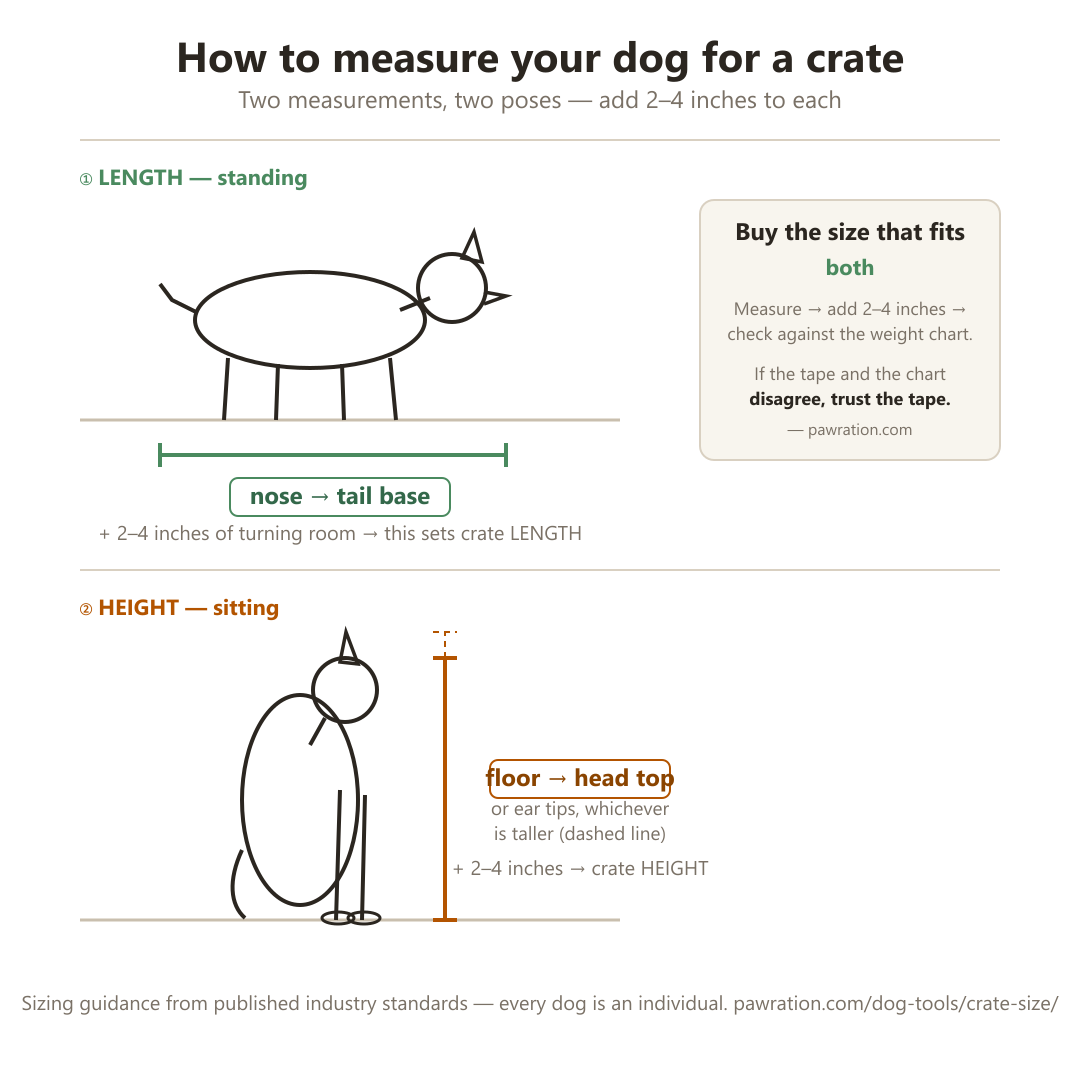
- Length (sets crate length): nose tip → base of tail, dog standing. Add 2–4 inches.
- Height (sets crate height): floor → top of head, dog sitting. Add 2–4 inches.
- Buy the size both measurements fit; if your tape says one size up from the chart, trust the tape.
Frequently asked questions
What size crate does my dog need?
Start from the weight chart above, then verify with a tape measure: crate length = your dog's body length (nose to base of tail) plus 2–4 inches of turning room; height = floor to top of head while sitting, plus 2–4 inches. The chart handles the breed average; your tape measure handles your dog.
Should I crate train my dog at all?
Most veterinary behaviour guidance treats a crate as a tool, not a requirement: introduced positively it becomes a den dogs choose themselves — invaluable for travel, recovery from surgery, and safety when unsupervised. Introduced punitively it backfires. Size and padding matter more than brand.
Puppy or adult crate size?
Buy the adult size with a divider panel — the divider shrinks the space to "stand, turn, lie flat" at every growth stage, which also teaches clean crate habits. One well-made crate covers the whole journey.
Is a bigger crate better?
No — a crate that is too big defeats the den instinct and, for puppies, leaves a corner to soil. The right size is snug with 2–4 inches of clearance, not roomy.
What kind of bed should go in the crate?
A pad thick enough that ribs and hips don't press the pan — 2–4 inches is the usual comfort range. Short-coated and bony breeds (Greyhounds, Pit Bulls, Great Danes) need the thicker end of that range or thicker; bare pans invite pressure sores and elbow hygromas in these breeds. Cut to fit so it doesn't bunch and create a corner to soil, and pick bedding your dog cannot shred and swallow.