Newfoundland weight chart (kg & lbs)
Healthy weight ranges for a growing Newfoundland, male and female — plus the hands-on test that tells you more than any chart: body condition.
Puppy growth chart — male & female (kg · lb)
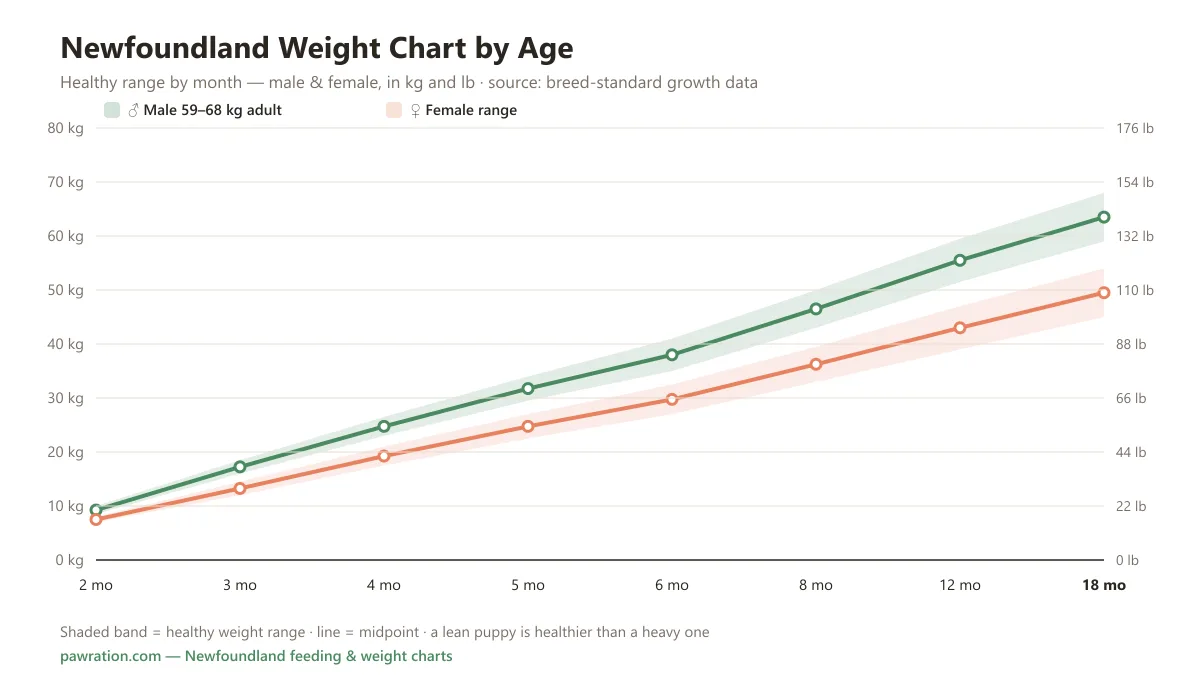
♂ Male
| Age | Healthy range (kg · lb) |
|---|---|
| 2 mo | 8.5–10 kg · 19–22 lb |
| 3 mo | 16–18.5 kg · 35–41 lb |
| 4 mo | 23–26.5 kg · 51–58 lb |
| 5 mo | 29.5–34 kg · 65–75 lb |
| 6 mo | 35–41 kg · 77–90 lb |
| 8 mo | 43–50 kg · 95–110 lb |
| 12 mo | 51.5–59.5 kg · 114–131 lb |
| 18 mo (mature) | 59–68 kg · 130–150 lb |
♀ Female
| Age | Healthy range (kg · lb) |
|---|---|
| 2 mo | 7–8 kg · 15–18 lb |
| 3 mo | 12–14.5 kg · 26–32 lb |
| 4 mo | 17.5–21 kg · 39–46 lb |
| 5 mo | 22.5–27 kg · 50–60 lb |
| 6 mo | 27–32.5 kg · 60–72 lb |
| 8 mo | 33–39.5 kg · 73–87 lb |
| 12 mo | 39–47 kg · 86–104 lb |
| 18 mo (mature) | 45–54 kg · 99–119 lb |
A puppy slightly lean is healthier than slightly heavy — especially for large breeds. Reference: Weight: AKC official standard (dogs 130-150 lb / 59-68 kg; bitches 100-120 lb / 45-54 kg), consistent with FCI No. 50 averages (~68 kg male / ~54 kg female); Wikipedia typical ranges run broader (65-80 / 55-65 kg); growth midpoints per giant-breed developmental ratios (estimate); puppy calcium: AAFCO large-breed guideline (0.7-1.2%); GDV meal management: AVMA guidance.
The test that beats the chart: body condition score
Charts describe populations; your dog is an individual with a frame size and muscle mass the chart can't see. The 9-point body condition score (BCS) takes 30 seconds, no equipment:
| Check | Lean (BCS 4–5) ✓ | Overweight (BCS 6+) |
|---|---|---|
| Ribs | Felt with light finger pressure | Have to press to find them |
| Waist (from above) | Visible tuck behind ribs | Straight or bulging sides |
| Belly (from the side) | Clear upward tuck | Sags or hangs level |
My Newfoundland is above or below the chart — what should I feed?
If your Newfoundland sits above or below the range, the calculator adjusts portions for their actual weight and life stage — and if ribs are getting hard to feel, it takes 10% off the ration for you.
Frequently asked questions
How much should a Newfoundland weigh at 6 months?
A healthy 6-month-old male Newfoundland typically weighs 35–41 kg (77–90 lb), and a female 27–32.5 kg (60–72 lb) — but the trend matters more than any single number. A puppy tracking smoothly along the chart is healthier than one hitting exact midpoints.
When is a Newfoundland fully grown?
Newfoundlands are a large breed: height finishes around 12 months, but final muscle fill and chest development continue to 18–24 months. Expect the scale to keep creeping up slowly after growth plates close.
How do I know if my Newfoundland is overweight?
Use the body condition score, not just the scale: you should feel ribs with light finger pressure, see a waist from above, and see a tuck from the side. On a 9-point BCS scale, 4–5 is the target. Lean dogs live measurably longer — the Purina LifeSpan Study showed ~1.8 extra years (Kealy et al., 2002).
My Newfoundland is above the chart range — what should I do?
First check body condition: muscular dogs can legitimately sit above the breed's typical range. If ribs are hard to feel, reduce daily food by 10%, hold two weeks, re-weigh — and ask your vet to rule out medical causes before any bigger cut.